Pisciculture
According to FAO (United Nations Organization for Food and Agriculture), fish farming is "the activity focused on the cultivation of aquatic organisms, both in coastal areas and inland, which implies interventions in the breeding process, to increase the production".
Glossary
Record keeping Forms at a Fish Facility
Overview
The conformation of any type of fish project must begin with the planning of the different activities, needed equipment and supplies in general, required for the good development of the activity and reach the point of turning it into a profitable company; The foregoing should be accompanied, at the same time, by the creation and use of forms where all movements are registered, which will be the basis of the traceability of the aquaculture facility.
From the administrative side, the different plans and programs should be organized, with their respective forms and action plans and protocols (steps to follow in the development of each activity) that will lead fish production.
Likewise, special attention should be paid to management quality policies, which could be summarized in the following example:
MANAGEMENT REVIEW
Participants
Name - Position
Results of the audits
(Analysis and Recommendations)
Customer Feedback
(Analysis and Recommendations)
Review of Quality and Objective Policies
(Analysis and Recommendations)
Changes in Activities
(Análisis y Recomendaciones)
Recommendations
Action plans
Responsable
Date
Tracing
Traceability
Traceability is considered one of the tools used to track the origin of the product, which in this case could be tilapia, trout, salmon, carp, etc., the basis of production, and its supplies within the food supply chain (fish feed, medicines, etc.), which allows identifying and registering each item, from its origin to the end of the marketing chain, that is, the consumer.
The different traceability systems complement and improve the management of any fish production unit and facilitate the work, either within the fish farms, feed mills, transport and distribution, in the case of the fish trading houses, by having organized, systematized and functional records adapted to the needs of each fish facility. Concluding, the traceability, within the food chain, provides greater security within all stages, as well as to the consumer of the product and allows the positioning and good name of a fish farm, making it a recognized brand in the market.
Finally, traceability allows to quickly identify the path traveled by a product that presents a problem, its withdrawal from the market, if necessary, reducing economic and commercial image damages, as well as generating the possibility of selling products in more profitable markets. and even export them.
Creating a Fish Farm Project
Justifications
The unfortunate participation of man in the process of deterioration of the environment and the accumulation of contamination in hydrographic basins, lakes, lagoons and, of course, the sea, have led to the decrease of fish in their different habitats and consequently, the decrease of food for human beings. Consequently, it has become necessary to breed fish in artificial media or in suitable places for their growth, with optimal environmental conditions, although these imply additional costs in their culture.
Fish farming is also a formula that helps to conserve endangered species, and that allows research with endemic species, which augurs a future appropriate exploitation of the resource. These investigations and projects will guarantee a sufficient quantity of meat and derivatives for human consumption and will prevent the extinction of the species as such.
Fish farming has great benefits, because it improves families' nutrition and with the sale of the product, economic income is increased; With fish farming, farms are valued, non-productive land is used and companies can be created, generating work options for the community in the area of influence.
Creation of Ponds
To start a fish farming project it is essential to have water and land.
The water can be obtained from a river, stream, rain or natural source; but, it is necessary to avoid taking it from those rivers or streams that supply the aqueducts. It is recommended to locate the pond near the house, to facilitate the surveillance and care of the fish; In addition, it is important to take advantage of land that is not suitable for agriculture and has a slight incline.
If a flooded natural area is available for the aquaculture project, another group of materials will be required. When using a natural lake or dam, the water inlets and outlets must be taken into account, which will allow the exchange of the liquid and its respective oxygenation.
Type of soil for the creation of Ponds
The pond for fish farming requires a clay soil that prevents water seepage. Therefore, before starting to build the pond, check the capacity of the soil to retain water. Sandy or gravelly soils retain little water; when trying to build a pond in these classes of soils, it is necessary to waterproof the land, which implies an additional cost.
Pond Construction
Once the land has been selected, the vegetation is removed. The banks of the pond under construction are marked, leaving a strip 1.5 meters wide, on which the walls or slopes of the pond will be raised; the grass and about 20 or 25 centimeters of black soil are removed from the first layer.
The earth should be dug out and deposited on the strip that is left for the walls in such a way that a sloping wall or slope is formed; then it is rammed tightly. The inclination of the slopes ensure a firm consistency of the walls avoiding their collapse.
Then, sufficiently tamp the bottom of the pond and give a slight slope towards the site where the drainage system will be installed. The water inlet should be located in the shallow part of the pond, while the drain is better to build it in the deepest part. At the water inlet and outlet, it is recommended to place fine-weave plastic meshes.
For the outlet or exchange of the water, a PVC pipe and elbow must be used. Do not stick the PVC elbow to be able to turn it down or up. This procedure allows the control of the quantity or level of the water in the pond. A different technique consists in placing another one with a larger diameter on the drain pipe, so that the replacement water comes out of the deepest part and the rest, remains in good quality conditions; although in general, this system is used for ponds with permanent water inlet.
At the end of the construction of the pond, place on the highest part of the slopes and embankments, the grass previously removed, to prevent the rainwater from deteriorating and eroding them.
Prepare Ponds for Stocking Fish
One week before sowing, it is necessary to fill the pond halfway to check if there are water leaks, if it completely fills, observing its levels and if there is a good water exchange; Afterwards, dry the pond and apply one kilogram of lime, for every five square meters, distributing it throughout the bottom and the walls of the pond. After a day, fill the pond halfway.
Finally, fill the pond completely, avoiding the entry of strange animals.
Daily Pond Maintenance
- Maintain the water level
- Check the water inlet and outlet filters
- Control excessive weed growth on slopes and avoid aquatic weeds
- Keep the pond clean of food residues, leaves, stems, etc.
- Keep strange animals that eat fish away.
Floating cages for fish culture
Characteristics of Floating Cages
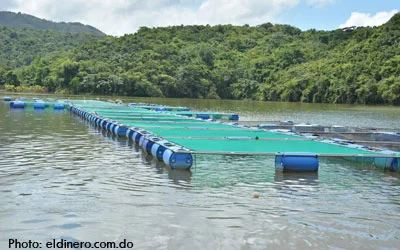
Basically, floating cages are structures that give rigidity and shape to the mesh or net that delimits a volume of water and in where the fish are introduced to proceed with their cultivation. It is convenient, and even essential, to equip the cages with flotation capacity, which implies complementing the cage with an anchoring system to prevent its uncontrolled displacement by the possible action of winds or water currents.
Floating cages can have very different shapes: circular, square, rectangular, hexagonal, octagonal, etc.
The fish container tank is usually a net, generally made of nylon with or without knots, with a mesh size according to the size of the fish. It is preferable to use the one with the greatest possible light, in order to reduce the adherence of algae and facilitate the exchange of water. The algae that develop in the nets are usually a problem that forces them to be changed several times in the same productive period, since the adhering ones impede the passage of water and consequently, a periodic washing of the meshes becomes imperative.
The depth of the nets usually varies between two and six meters, depending on the dimensions of the structure, the speed of the currents and, fundamentally, on the fish species that is the object of cultivation.
The place with the greatest risk of mesh breakage is the most superficial strip of the net, that is, the one that is located on the water-air horizon, since logs or other floating materials, carried by currents and subjected to a movement of Swaying through the waves, they tear the nets easily. Also the boats and the propellers of the motors, especially when they are handled with routine practice or by personnel outside the fish farm, can also cause this accident.
The flotation system of the cage depends on the type of structure that supports it, but in no case should it have a capacity less than thirty kilos of flotation per square meter of surface of the cage in plan. To achieve the flotation of the structure, environmentally friendly elements are used, metallic or plastic drums completely filled with a stable product, etc. It is important to distribute the buoyancy along the perimeter to provide it with great stability.
The anchoring system can consist of a simple ballast thrown to the bottom of the reservoir and to which the cage is fastened with a cable or rope, up to some ropes that connect the cages with the opposite margins of the banks. The choice of the system depends of the characteristics of the reservoir.