Glossary - Vocabulary
Aeration: Insertion of Oxygen into the culture media.
Aerator: A machine used for aeration of aquaculture ponds and tanks.
Amphidromous fish: Migratory fish that live in both fresh and salt water, independent of breeding.
Anadromous fish: Migratory fish that live in salt water but breed in fresh water.
Aquaculture: Also known as aquafarming; it is the controlled growth of aquatic species.
Brackish water: Water with salt concentrations ranging between 5-15 ppt salinity and suitable for aquaculture production for certain species.
Brood stock: Fish of any particular species which are raised for reproduction purposes. The parental breeding flock, both males and females, which are used to produce the "seed" of the cultured organism (fish-fry, shrimp post-larvae, etc) for stocking the aquaculture facility.
Catadromous fish: Migratory fish that live in fresh water but breed in salt water.
Contaminants: Both natural and artificial materials not typically found or found in unusually high concentrations which can be detrimental to the health of wild or farmed aquatic species.
Culture tanks: Artificial holding areas used to rear fish farm stocks.
EBIDA: Earnings Before Interest, Depreciation and Amortization. An indicator of a company’s economic performance.
Edible fish: Fish species that are considered suitable and acceptable for consumption by humans.
Extensive aquaculture: Managed aquaculture dependent on the local natural setting, such as a pond or coastal sea area.
FAO: Food and Agriculture Organization of the United Nations.
Feasibility study: The technical and financial analysis of a proposed aquaculture venture to determine if it is economically viable.
Fingerling: Development stage of fish following the fry stage and continuing into the first three to four months of life.
Fish farm: Locations used to grow populations of aquatic organisms, primarily fish.
Fish hatchery: One form of a fish farm, managed with the intent of resupplying native wild populations in natural environments.
Fish husbandry: The breeding and rearing of fish for a variety of reasons.
Fish kill: A description of the number of fish stock to die in a specific amount of time.
Fish meal: Commercially processed food source used in fish farming as a source of protein for the fish stock.
Fish nursery: The first production stage in fish farming, nursing fry (about 1.0 gram) to fingerling (60-100 gram).
Fresh tilapia fillet: The fillets portions of tilapia fish, skin-on or skinless, in fresh non-frozen form.
Fry: Development stage of fish immediately after the larvae stage, at an age of less than a week.
Game fish: Fish, such as trout, raised to become replenishment stock for natural sport fisheries.
HACCP: Hazard Analysis and Critical Control Point. A quality control method, required in all seafood processing plant exporting to USA and EU.
Hatchery: The aquaculture production stage in which crop organism hatches from eggs and grows to stocking size.
Hormone: Biologically active molecules functioning in all higher organisms, and regulating life processes.
Hormone-free seafood: Seafood that was produced without external application of hormones.
In vitro fertilization: Artificially fertilizing fish eggs in a laboratory setting.
Intensive aquaculture: Managed aquaculture controlled through human engineered means, such as managing water quality and sources of food.
IRR: Internal Rate of Return. Indicator showing the internal rate of return for a series of cash flows.
NMFS: National Marine Fisheries Service. A USA Government Agency, responsible for various aspects of USA Fisheries and Seafood.
NPV: Net Present Value. Indicator showing the return of the net present value of an investment based on a discount rate and a series of future payments and income.
Oceanodromous fish: Migratory fish that move within salt water only.
Organic fish: Fish produced using organic concepts and natural procedures, minimizing input of artificial man-made compounds.
Ornamental fish: Small fish, such as koi, which are typically grown to be kept in aquariums or small landscape ponds.
Overfishing: Detrimental practice of removing more of a natural aquatic species than what natural reproduction can support.
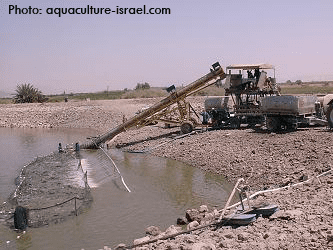
Pesculator: Fish elevator used for harvesting live fish from pond harvesting pit, to Fish Sorting Machine of Fish Transfer Tanks.
Pisciculture: Aquaculture; practice involving finned fish.
Polyculture: A food production system, which grows several species simultaneously in the same space. In aquaculture, growing multiple aquatic organisms in the same water body.
Pond acreage: Area committed to extensive aquaculture holdings at a fish farm or company.
Pond design: The conceptual and engineering design of an aquaculture pond, according to the requirements of the crop organism and site conditions, with the aim of achieving cost effective production and maximum profit.
Potamodromous fish: Migratory fish that move within fresh water only.
Processing plant: The building structure that houses the processing equipment and auxiliary systems, used in the fish Processing Plant, for the purpose of preparing fish portions prior to marketing. Processing equipment include machines for cleaning, sorting, scaling, eviscerating, filleting, trimming, cooling or freezing and packing fish and fish portions, prior to marketing.
ROI: Return On Investment. Indicator showing the economic rate of return of a capital investment.
Secchi disk: The Secchi disk (or Secchi disc), as created in 1865 by Angelo Secchi, is a plain white, circular disk 30 cm (12 in) in diameter used to measure water transparency or turbidity in bodies of water. The disc is mounted on a pole or line, and lowered slowly down in the water. The depth at which the disk is no longer visible is taken as a measure of the transparency of the water. This measure is known as the Secchi depth and is related to water turbidity.

Sex reversal: Reversing the sex of males or females in fish can be accomplished by hormone application at the larval stages, from day 2-to 20 after hatching. In some fish species, sex transformation from males to females and vice versa occurs naturally. The purpose of sex reversal in tilapia culture is to enable production of all-male populations, considering that females are less economical to raise, due to their early age fecundity and lower body weight.
USDA: United States Department of Agriculture.
Water Quality: The characteristics of water, such as water temperature and contamination, which define its ability to sustain life and its purity from chemicals.
Wild fishing harvest: The commercial and personal fishing consumption in a specific area and over a specific time frame.
Yearling: Development stage of fish following the fingerling stage and lasting until approximately one year of age.