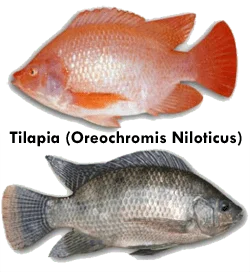
Tilapia (Oreochromis niloticus)
Tilapia is the generic name of a group of cichlids endemic to Africa. The group consists of three aquaculturally important genera Oreochromis, Sarotherodon and Tilapia. Several characteristics distinguish these three genera, but possibly the most critical relates to reproductive behavior. All tilapia species are nest builders; fertilized eggs are guarded in the nest by a brood parent. Species of both Sarotherodon and Oreochromis are mouth brooders; eggs are fertilized in the nest but parents immediately pick up the eggs in their mouths and hold them through incubation and for several days after hatching. In Oreochromis species only females practice mouth brooding, while in Sarotherodon species either the male or both male and female are mouth brooders.
Historians, based on illustrations found in Egyptian tombs, suggest that Nile tilapia (Oreochromis niloticus) was one of the first cultured species.
During the last half century fish farmers throughout the tropical and semi-tropical world have begun farming tilapia. Today, all commercially important tilapia outside of Africa belong to the genus Oreochromis, and more than 90 percent of all commercially farmed tilapia outside of Africa are Nile tilapia. Less commonly farmed species are Blue tilapia (O. aureus), Mozambique tilapia (O. Mossambicus) and the Zanzibar tilapia (O. urolepis hornorum). The scientific names of tilapia species have been revised a lot in the last 30 years, creating some confusion. The scientific name of the Nile tilapia has been given as Tilapia nilotica, Sarotherodon niloticus, and currently as Oreochromis niloticus.
Positive aquacultural characteristics of tilapia are their tolerance to poor water quality and the fact that they eat a wide range of natural food organisms. Biological constraints to the development of commercial tilapia farming are their inability to withstand sustained water temperatures below 50° to 52° F (10° a 11° C) and early sexual maturity that results in spawning before fish reach market size.
Tilapia has become the third most important fish in aquaculture after carp and salmon.
Developmental Stages of Nile tilapia (Oreochromis Niloticus)
SEX REVERSAL
Male tilapia are preferred for culture because of their faster growth. Of the various techniques that have been developed to provide male tilapia for culture,
sex reversal is the most commonly used procedure. Exogenous steroids given during the gonadal development period can control the phenotype overriding the expression of the genotypically determined sex. This process is commonly referred to as sex reversal.
Therefore, the idea is that the larvae or fry (fingerlings) are formed as males, feeding them during the first month of life, with feed mixed with male hormones.
INICIAL STAGE
Feed with 45% protein. For larvae and fry, from 0.1 to 25 gr.
GROWTH STAGE
Feed with 38% protein. To strengthen the vital organs of young fish and to achieve a growth of 0.9 to 1 gr per day.
FATTENING (ON-GROWING) STAGE
Feed with 32% protein. For growth and accumulation of muscle tissue in fish between 80 and 400 gr.
FINAL STAGE
Feed with 28% protein. To achieve the maximum growth in sizes between 400 and 800 gr of body weight.
Amount of feed per day
The daily feed ration to be supplied and the percentage of protein, are calculated based on the number of fish in the lot, multiplied by their weight and multiplied by the percentage of feed resulting from the biomass, according to the analysis table (chart) made by FAO.
| Weight (gr) | % Rate | % Protein |
|---|---|---|
| 1-14 | 10% | 45% |
| 15-20 | 6% | 45% |
| 21-34 | 5% | 45% - 38% |
| 35-44 | 4% | 38% |
| 45-54 | 3% | 38% |
| 55-229 | 2.5% | 38% - 32% |
| 230-330 | 2% | 32% |
| 331-380 | 1.9% | 32% |
| 381-432 | 1.8% | 32% - 28% |
| 433-516 | 1.6% | 28% |
Example (Feeding Rate)
If you have 5,000 fish weighing 1.8 grams, then, according to the chart (1-14 gr), apply 10% of feed, according to the biomass.
5,000 fish X 1.8 gr = 9,000 gr
9,000 gr X 10% = 900 gr of feed with 45% protein.
Carp Salmon