Description
Food is part of the fundamental aspects to guarantee sustainable development in fish production and represents close to 80% of production costs.
Objetive
The food and nutrition program aims to provide the necessary information about food at different stages of production, which includes quality, management and commitment to the environment.
Scope
Explain the actions aimed at guaranteeing the traceability and control of all activity.
Definitions
Define raw materials, biomass and traceability.
Regulations
Include statutory decrees.
Responsible
TThose responsible for this activity, in its different stages, are the operators in the production area, who must follow the guidelines of the fish farming project.
Procedures
Verification through critical analysis of the operating methods that are being used in the organization is important.
The basic steps would be:
* Planning of the audit program
* Auditors selection
* Internal auditors profile (Education, Training, Experience, skills, etc.)
* Preparation of internal audit plan
* Execution of the audit (Opening meeting, Interviews, Observation, Review, Closing meeting, Preparation and delivery of the audit report)
* Performance evaluation
* Monitoring and review of the audit program.
Control
The control will be done through audit formats, Verification, Control Points, Report, Non-conformities, preventive and corrective actions (Include deadlines).
Feed and nutrition program in a fish facility
Food Ration and Conversion
The management of the quantities and types of food to be supplied must be controlled and evaluated in order to improve production efficiency, which can be achieved through periodic sampling, taking an average sample of 10% of individuals per batch. Then the amount of food consumed during the measured time is reviewed and the following formula is performed:
FCR (Feed Conversion Ratio) = food consumed / biomass
A value between 1 and 2 should be found, with 1 being the best conversion.
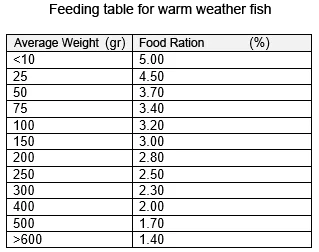
The ration for each of the production units must be calculated according to the weight of the animals:
Amount of food = Kilos / day = Bio X % of table
The biomass calculation is obtained:
Bio = W X N / 1000
Where:
Bio = Biomass in kilograms
W = Average weight of the animal in grams
N = Number of fish in the pond
Table % = It is the value found in the feeding table at the average temperature of the pond water and the average weight in which the fish are.
Fish Food Inclusion Factor (FFIF)
The inclusion factor of Fishmeal and fish oil refers to the quantities of fishmeal and wild fish oil used to obtain 1 ton of fish farmed in the project.
Historically, this ratio in fish farming was considered 50 kg of oil and 225 kg of fishmeal. In other words, for 1 ton of farmed fish, 50 kg of oil and 225 kg of wild fishmeal were required to be viable.
In the case of tilapia, the constant percentages and the analysis formula are:
Fish Food Inclusion Factor (FFIF) = (%Fishmeal + %Fish Oil) / (22.5% + 5%)
Fish In:Fish Out (FIFO)
FIFO is the calculation of the number of kilograms of wild fish that are required to produce one kilogram of farmed fish, multiplied by the conversion index (FCR).

FIFO = FFIF * FCR
Download FIFO - FFIF Calculation Formula (Example)
Fish Farming Management Plan Forms